
Overview
Sponsored by the Associate Vice President for Campus Sustainability, this initiative is working to address Scope 3 emissions, including establishing universitywide Scope 3 emissions goals.
Across two phases of work, we have assessed U-M’s current state, identified opportunities and focus areas, and engaged with the U-M community to understand your priorities. Stakeholder involvement has been crucial and we thank our partners and the broader U-M community for your expertise and passion as we strive for meaningful and scalable impact on behalf of people and planet.
Phase 1: Emissions Analysis and Planning
The Scope 3 Emissions Analysis and Planning Project from mid-2024 to February 2025 laid the groundwork for U-M to fulfill its commitment to establishing Scope 3 goals by the end of 2025.
In partnership with Buro Happold Consulting, the project:
- Performed a gap analysis of U-M’s Scope 3 data and sequenced steps to improve the data
- Developed a methodology and strategy for ongoing Scope 3 inventory tracking
- Engaged 350+ U-M community members to understand their priorities
- Defined strategies for ongoing Scope 3 management and impact
After integrating community feedback, key outcomes included recommendations to improve data quality, create tracking methodologies, and prioritize actions to address indirect emissions across our value chain. Learn more in the executive summary:
Phase 2: Targeted Analysis and Goal Development
In 2025, OCSI and the SEAS Center for Sustainable Systems partnered to delve deeper into priority areas and identify levers that could be deployed to achieve goals. This project was supported by the Scope 3 Advisory Council and engaged with working groups, students, and other key stakeholders.
Building on the Phase 1 assessment completed by Buro Happold, this project focused on four Scope 3 categories:
- Business travel
- Food
- Capital goods (construction)
- Purchased goods and services
These categories were selected as initial focus areas based on emissions impact, the university’s ability to influence, and visibility among the campus community. U-M intends to expand upon these initial focus areas over time.
Goal Adoption
This phased work established a strong analytical foundation for future goal setting. Following recent senior leadership transitions, the university plans to complete Scope 3 goal-setting work in 2026.
Parallel to goal-setting, OCSI and partners are working to publish U-M’s baseline Scope 3 inventory, make iterative improvements to data quality, and build the capacity for effective Scope 3 emissions reduction.
Across industry and higher education, Scope 3 emissions management is a complex, ever-evolving effort. We expect to iterate as we learn, partner with the U-M community to successfully reduce the impact of our indirect emissions, and broaden and deepen our efforts over time.
Engagement Opportunities
Join the above email list for occasional updates about Scope 3 emissions.
What are Scope 3 Emissions?
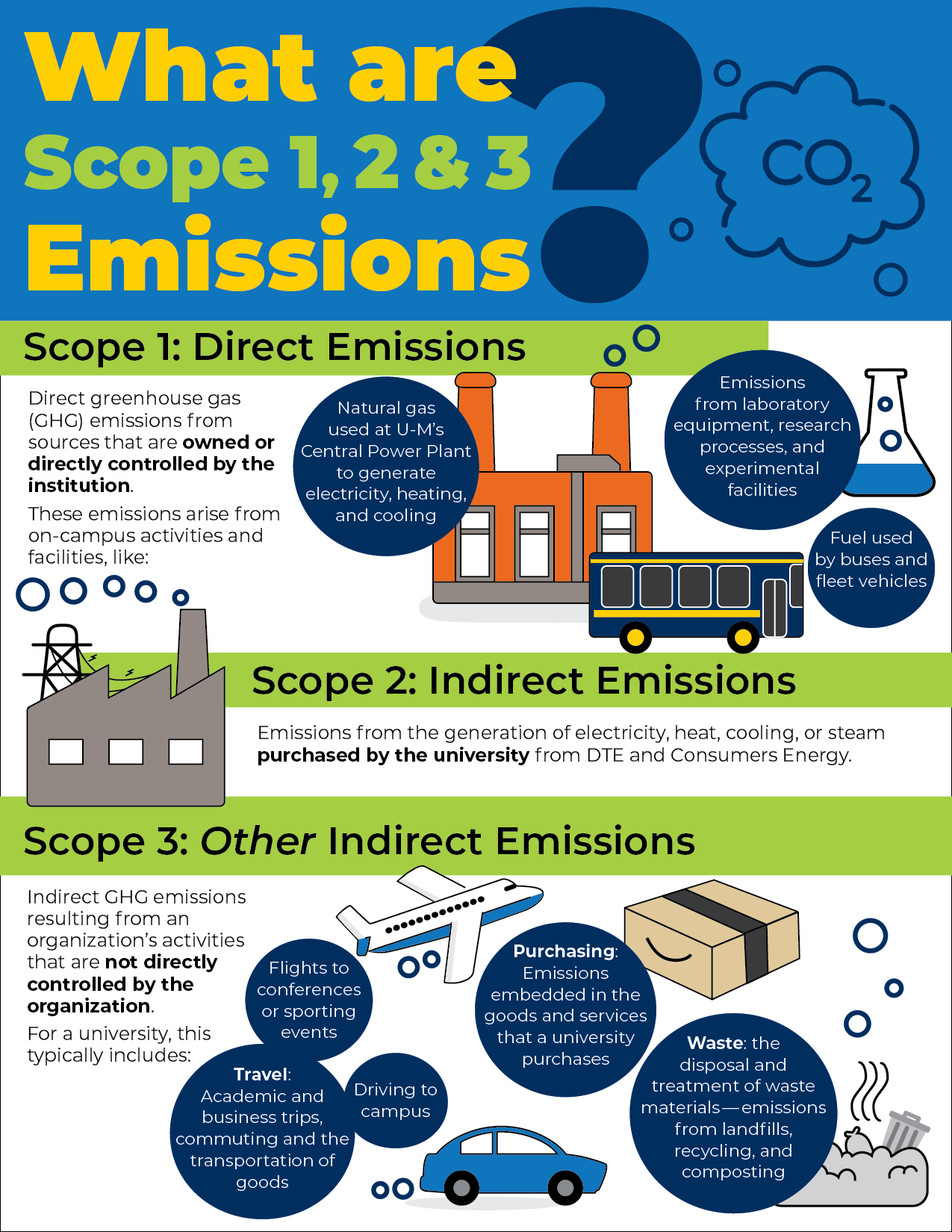
Scope 3 emissions are the indirect greenhouse gas emissions resulting from a university’s activities that are not directly controlled by the university. These include emissions from purchased goods and services, university-sponsored travel, commuting, waste disposal, and others across 15 categories. Because these emissions come from diverse and indirect sources, they are often the hardest to measure and reduce.
Project Team and Leadership
Sponsor:
Shana Weber,
Associate Vice President for Campus Sustainability and Innovation
Project Manager:
Katrina Folsom,
Office of Campus Sustainability and Innovation
Advisory Council:
Chip Amoe,
Sustainability Officer, U-M Health
Andy Berki,
Executive Director, Office of Campus Sustainability
Alex Bryan,
Director of Sustainability, Student Life
Michele Christensen,
Design Manager and Sustainability Coordinator, Architecture, Engineering and Construction
Anya Dale,
Campus-as-Lab Manager, Office of Campus Sustainability and Innovation
Tony Denton,
Senior VP and Chief ESG Officer, U-M Health,
Ken Keeler,
Lead Sustainability Analyst, Office of Campus Sustainability and Innovation
Geoff Lewis,
Research Specialist, Center for Sustainable Systems
Benjamin Morse,
Director of Strategy, Office of Campus Sustainability and Innovation
Ashley Ouendag,
Procurement Operations Manager, Procurement Services
Chip Reese,
Director, Procurement Services
Sachi Patil,
Student Representative, SEAS MS
Tally Thrasher,
AVP and Chief Procurement Officer, Procurement Services