
Temperature Tuning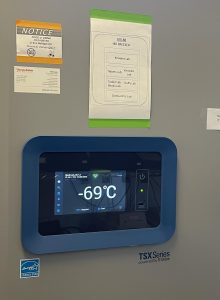
Did you know that ultra-low temperature (ULT) freezers consume as much energy as one average US household? Did you know that you can reduce that energy consumption by 30% just by raising the temperature by 10°C? In fact, ULTs used to be held at -65°C or -70°C. The switch to -80°C was not rooted in evidence showing that samples have greater stability at -80°C, but rather as a marketing tool.
Hear it from labs at U-M who have raised temperatures to -70C and these labs across the country that have been storing samples at -70° for years.
Other Best Practices
An unmaintained freezer uses 12-25% more energy than a maintained one! Taking care of your units is one of the most important things you can do to save your freezer, your samples, and your energy. One study found that 30% of samples within ULT freezers are out of date or unusable. Assess what is good in your freezers and what can be removed – maybe you could even get rid of a unit!
Before you start your defrost, make sure you know how to do it safely with EHS’s Official Defrost Guide.
If you need any supplies, OCS has a free freezer maintenance kit for defrosts or just general maintenance, such as cleaning your filters and condensers.
If you are in the School of Public Health, LSA, or the Dental School, your colleges have spare freezers you can request to temporarily store your samples during defrosts.
While doing cleanouts, assess what materials you have that can be stored at -70°C or -20°C or even at room temperature. Studies have shown that some DNA and RNA can be stored at room temperature without denaturing.
All of these actions can score your lab points on the Freezer Challenge! Winners can get recognition and awards. A challenge runs every January to July!
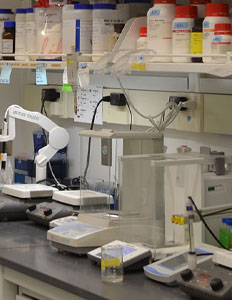 Benchtop equipment and plug loads can account for 15-25% of a lab’s energy footprint, depending on the lab space type. While turning off your equipment can be impactful, the best action you can take is unplugging the equipment from your outlets. For items that you need at a certain temperature during the day, you could consider implementing outlet timers so the device powers off and then back on when desired.
Curious about how much energy your equipment uses? Use our Kill-A-Watt Meter Lending Program so you can strategically use your equipment to minimize energy use.
Fume hoods are the single most energy intensive piece of equipment in labs, using the same amount of energy as 3.5 US households! The easiest thing you can do is shut the sash. By shutting that sash, you can reduce the unit’s energy consumption by more than 40%.
- OCSI has reminder stickers that you can stick to the hood so people remember to close the sash when the unit is not in use.
- If you aren’t using your fume hoods for hazardous fumes, open flames, or flammable liquids, consider decommissioning the unit. This closes off the air system and results in huge energy savings. If you do so for at least 1 year, OCS will cover the cost.
Biosafety cabinets can use the same amount of energy as ½ a US household a day! Similar to fume hoods, make sure you shut that sash when not actively working in the cabinet to stay safe and save energy. You can also turn them off at the end of the day when not in use to save energy. Turning off your Biosafety Cabinets can reduce energy consumption by 99%.
- EHS does not recommend nor require using UV lamps in BSCs for sterility. Instead use a solution of 70% ethanol and run the hood for air circulation. Looking to dispose of your UV light bulbs? Learn more here.
- You can request free reminder stickers for turning off different types of BSCs
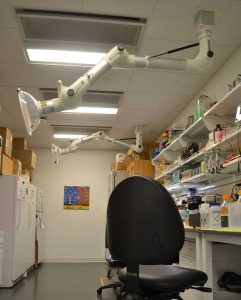 Snorkels are an alternative method of air suction in lab settings. To be effective, snorkels need to be within 4 to 6 inches of the chemical source. Like fume hoods you could consider decommissioning your snorkels for significant energy savings. A snorkel uses the same amount of energy as ⅙ of a US household a day!
If you use too much compressed or vacuum air at a time in your lab, neighboring labs can actually experience decreased air pressure in their spaces! Use this air smartly and only when needed since it is expensive to produce. If your house vacuum lines have any hissing noises, you should report that immediately by filling out a work order. If interested, OCSI has an ultrasonic camera we can use to identify leaks in your space.
Autoclaves are large energy and water consumers (60-90 gallons of water per load). One of the best things you can do is only running your autoclave when it is full. If you only have a few things that you need sterilized quickly, make a quick stop at your neighbor’s bay to see if they need anything autoclaved.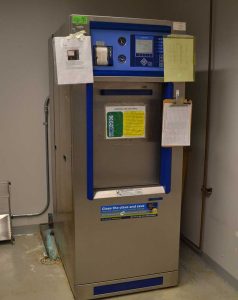
- When autoclaving, make sure you select the correct cycle for your items. Solid waste should use a gravity or fast exhaust cycle. Liquids should use a liquid or slow exhaust cycle. Wrapped goods, instruments, etc. should use a vacuum or fast exhaust cycle. A drying phase is optional, but recommended for wrapped goods. By choosing the safe cycle, you are actually choosing the sustainable cycle!
- Consider right-sizing your unit to fit your lab space better. Large steam-jacketed autoclaves use much more energy and water than a front-loading non-steam-jacketed autoclave. Purchase Energy Star certified units.
- Close the clave! Autoclaves produce heat so by closing the jacket you are preventing heat loss so the unit doesn’t have to work as hard. Request a reminder sticker.
- If you see steam vaporizing at the bottom of the autoclave or water constantly draining, report it since the valve is likely broken and needs to be replaced.
- Request a reminder sticker
Similar to autoclaves, make sure your dishwashers are only being run when full to maximize the efficiency of the unit.
- Did you know that Research Services will wash your glassware for you AND your reusable glass serological pipettes in the medical school? This can help eliminate disposable serological pipettes in your lab.
Single pass cooling should be eliminated and replaced with more efficient alternatives such as a closed loop chilled water system or air cooling system. These alternatives can save thousands of gallons of water per week. The LSA Chemistry Department has the most Findensers in the United States, which allow for zero water waste and no added energy costs! If you are in the LSA Chemistry Department, reach out to [email protected] to be connected with a free air cooled condenser.
If you notice a sink dripping, a brown stain appearing in the ceiling, or inefficient heating/cooling of your space, there is an issue that can’t be fixed unless you report it. These situations can result in wasted energy and water (up to 3,000 gallons per year for each leak). To report these issues, submit a general work order using this form. Make sure you get a work order number to ensure you are in the queue.
Did you know it takes 3 gallons of regular tap water to create 1 gallon of deionized water? OCSI strongly discourages making your own DI water. Instead find a nearby DI water tap that you can use or if your lab building has no such taps, you can purchase DI water.
- Only use DI water when experiments absolutely need it! Don’t use DI water for cleaning benches.