
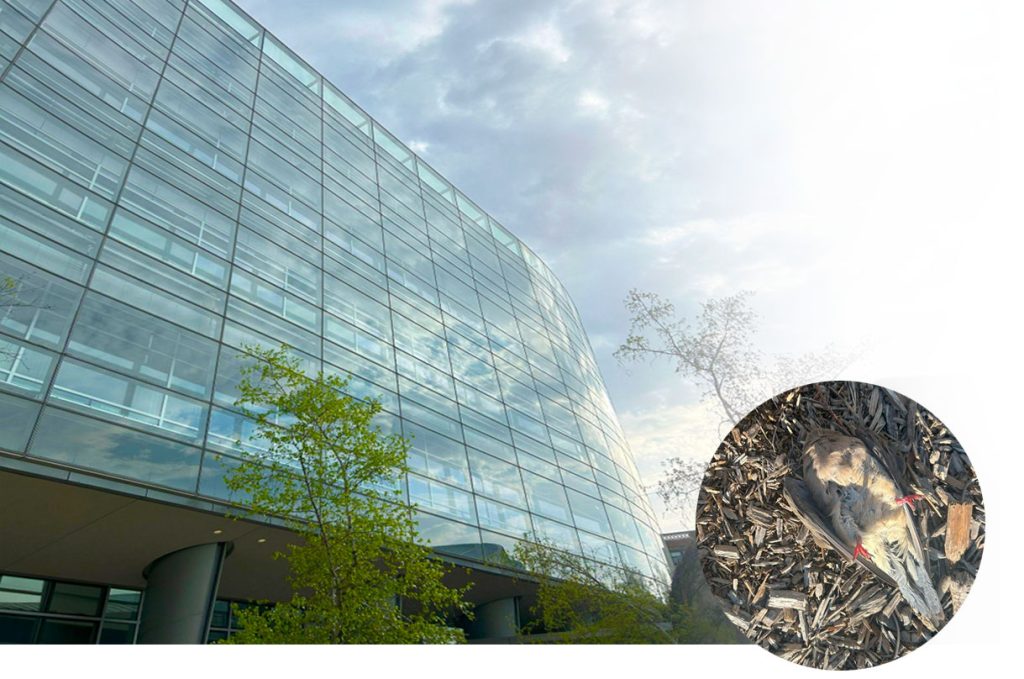
Windows on U-M’s Biomedical Science Research Building reflect the sky and adjacent vegetation, confusing birds and leading to collisions. This deceased mourning dove was found in the planting beds under the reflective windows.
The U-M Ann Arbor campus is committed to supporting resilient grounds, including increasing natural areas and biodiversity — and managing the impacts of our built environment.
Not-so-Fun Facts about Bird Decline
- In North America, the bird population has drastically decreased: nearly 30% since 1970.
- Building collisions are the second-highest source of direct human-caused bird mortality.
- It is estimated that building collisions kill 1 billion birds annually in the United States.
- Many collisions go unnoticed, as stunned or injured birds are typically quickly eaten by predators or move to covered areas.
Why Do Birds Collide with Buildings?
Most collisions occur during the day, when birds see reflections of the landscape in the glass or see through the glass to vegetation or sky on the other side.
Other building design considerations, such as building shape and location, can also impact collision risk. For example, curved or U-shaped buildings can confuse birds and make it difficult for them to go around the building.
At night, during spring and fall bird migrations, birds can be attracted to lighted structures, resulting in collisions.
Bird-Friendly Buildings
Learn about practices that minimize harm to birds.
Bird-Safe Decal Design Challenge
Help create a bird-friendly campus! Submit your design concept for window decals that make glass surfaces visible to birds.
The winning design will be used to retrofit windows at a campus hot spot for bird strikes, preventing impact-related deaths and injuries.
What U-M is Doing — and How You Can Help!
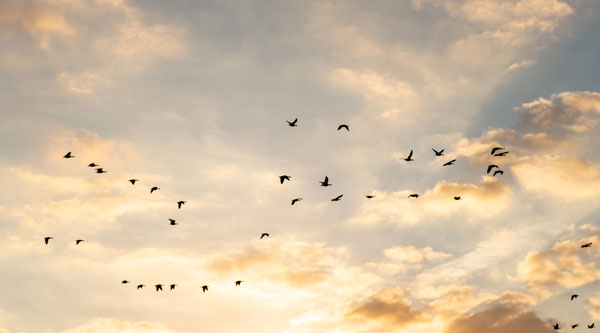
Twice a year, the skies above the U.S. are home to immense seasonal movements of billions of birds. In the fall, approximately 4 billion birds enter the U.S. from Canada, with October marking the height of the migration. Come spring, around 3.5 billion birds return from southern wintering grounds between March and June, peaking in April. These journeys shape ecosystems and signal seasonal change.
To protect birds during this epic migration and year-round, OCSI partners with the U-M Museum of Zoology to conduct seasonal bird collision inventories each spring and fall migration. The data informs efforts to update building design guidelines and helps identify high-priority buildings to retrofit with bird-safe measures.
Be part of a community contributing to high-quality data!
- Volunteer to help with the seasonal inventory. Volunteers are needed daily for the spring migration (April-May) and fall migration (September-October). If you are available for any portion of these timeframes and are interested in volunteering for one morning, the entire period, or anything between, let us know!
Volunteers are trained to look for injured or deceased birds and assigned to a few high-priority buildings for whichever date(s) they are available. Each building perimeter takes roughly 30 minutes to inventory, so shift length can range from 30 min-2 hours. All inventorying takes place in the morning.
Become a volunteer:
Fill out the Volunteer Interest FormDirect questions to:
[email protected] - Report an injured or dead bird any time of the year.