
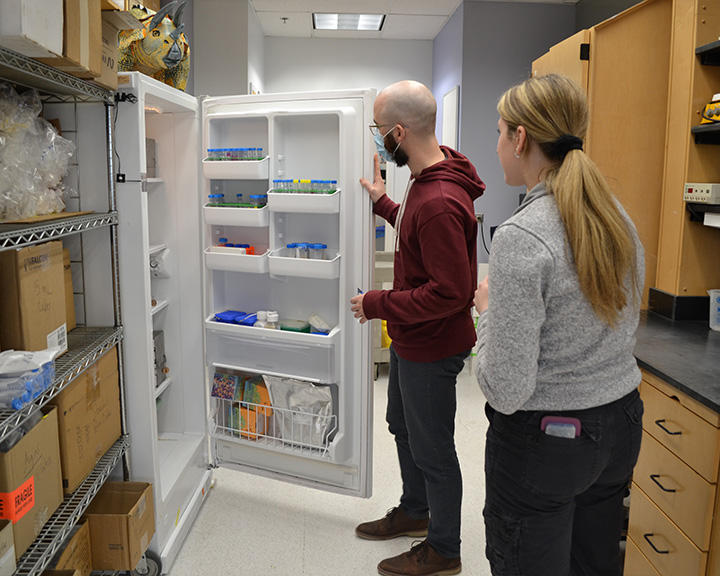
A laboratory freezer can use as much energy in a year as a residential home!
You can help reduce your lab’s environmental impact by joining the global Freezer Challenge.
U-M Freezer Challenge
The Freezer Challenge is a competition designed to promote best practices in cold storage management. U-M has thousands of freezers, which are a major contributor to our greenhouse gas emissions and energy costs. Best practices also benefit researchers directly by reducing costs and freeing up space for new samples.
The competition is run by My Green Lab and the International Institute for Sustainable Laboratories. Our role is to provide personalized, U-M-specific support and additional incentives to help U-M participants complete the challenge.
The 2026 Freezer Challenge has officially ended. The next challenge launches January 2027!
Why Participate?
- Reduce your lab’s carbon footprint
- Learn proper cold storage maintenance techniques to help avoid future failures
- Reduce the cost of maintaining extraneous cold storage units
- Removal of unneeded or unviable samples from cold storage units frees up space for new samples without the cost of purchasing additional refrigerators and freezers
- Recognition and awards!
How to Participate
The 2027 Freezer Challenge will launch January 2027! Learn more about how to join the challenge then and start tracking your actions today!
FAQ
The International Laboratory Freezer Challenge is a competition designed to promote best practices in cold storage management. The Freezer Challenge covers all forms of cold storage, including refrigerators, freezers, and cold rooms.
Any laboratory in the world can participate by signing up at https://freezerchallenge.mygreenlab.org/. Laboratories are defined as a group of people and their physical space working under one manager, researcher, or scientific mission.
The Freezer Challenge runs January 2027 to June 20, 2027. Scoresheets will be due by 11:59 PM PST on June 30. Labs are encouraged to work at their own pace to complete the Freezer Challenge during the intervening months.
Absolutely! Many labs register for the competition in February, March, April, or even later. You can count any actions on your 2027 scoresheet that your lab has done since July 2026, so if you cleaned out samples, defrosted units, updated inventories, or any of the other best practices from last July until now, you can count those on your scoresheet. Therefore, there is no disadvantage to registering after January. Go for it!
Freezer Challenge participants will benefit from:
- Reducing energy consumption, costs, and environmental impact of the lab
- Learning and applying proper cold storage maintenance techniques to help avoid future failures
- Removal of unneeded or unviable samples from cold storage units, freeing up that space for new samples without having to purchase additional refrigerators and freezers
- Reduced costs associated with maintaining extraneous cold storage units
- Improved researcher access to and security for viable samples
- Participation recognition, plus awards!
Labs will receive points for taking the actions listed under Best Practices part of the website, which mirror the Freezer Challenge scoresheet. In the vast majority of cases, each action per cold storage unit is worth 1 point unless otherwise described on the scoresheet.
For actions that also have an energy savings component, I2SL also estimates kwh/day saved. Once you submit your scoresheet, you will receive a preliminary estimate of your energy savings.
The Freezer Challenge is scored by looking at a combination of factors, including points earned, kWh saved, points earned per cold storage unit, and kWh saved per cold storage unit. The goal is to reward the labs and organizations that have earned the most points and saved the most energy through the Challenge. Check out the full scoring details.
Yes! The I2SL Freezer Challenge is a global competition. There are awards for winning the global competition. Also check out the How to Win the Freezer Challenge guide.
For the U-M competition, winners are selected based on points scored and energy saved.
- The 2026 challenge featured an Ice Cream Social Celebration for all participating labs.
In some cases, yes, such as if your ULT freezers are already set to -70 °C. For many scoresheet elements, I2SL asks participants in the 2027 Freezer Challenge to only report actions your lab has done since July 1, 2026. This system of reporting rewards the labs and organizations that have done the most actions in the past year, all the way up to the current competition deadline. Many of the preventative maintenance best practices highlighted by the challenge, as well as sample management strategies, should be done on a regular basis in all laboratories, so we are encouraging that by allowing labs to include actions taken since the prior year’s challenge ended.
Yes!
Medical School labs, please email [email protected].
All others, please email [email protected].
Check out this video on basic freezer maintenance (start at timestamp 1:20). It describes simple steps that are approachable for most people. EHS also has a Freezer Defrost Guide and OCS offers a free Freezer Maintenance Kit. Some units such as LSA, SPH, and the Dental School have a spare freezer available for defrost support. If you feel that you require additional assistance or are concerned about the operation of your equipment, please email [email protected].
The Lab Reuse Program may be able to rehome equipment and supplies you no longer need. Email [email protected] with a description of your items to see if they can be accepted. Please include your location and preferred pick-up time and day.
All questions related to the I2SL Freezer Challenge, score sheet, and portal should be directed [email protected].
For questions related to U-M freezer support or the internal U-M competition, email [email protected].
Questions? Email [email protected].
2026 Impact
Annual avoided energy consumption: 435,000 kWh/yr
Annual avoided emissions: 126 metric tons of carbon
Annual avoided utility costs: $60,000/yr
2026 Winners
Overall Winners
Large Lab (10+ members): CLASS Lab, SPH
Small Lab (<10 members): Watson Lab, Med School
Small Lab: DGG Molecular Genetics Lab
Small Lab: Chapman Lab
Large Lab: CLASS Lab
Small Lab: Meeker-Watkins Lab
Medical School Winners
Large Lab: Kahlenberg Lab
Small Lab: Watson Lab
Freezer Tips
Check out these tips to optimize the performance and efficiency of your lab’s ultra low temperature freezers.